BEYOND CONVENIENCE
ADDING NUTRITIONAL INTELLIGENCE TO FOOD DELIVERY
A Predictive Nutritional Coordination Layer For Health-Aware Food Discovery
Foodtech
Nutrition Intelligence
Behavioral UX
Goal-Based UX
AI-Assisted CX
The added feature transforms food ordering from a convenience transaction into a health-coordinated decision, whether users are ordering a prepared meal, cooking from a goal-aligned recipe, or doing both at once. Every suggestion is a starting point. Every decision belongs to the user.

PROJECT BACKGROUND
The Problem With Food Ordering For Health-Conscious Users
Convenience And Nutrition Have Been Optimized For Different Goals
Most food delivery platforms are built around a simple behavioral loop: browse, crave, order. That loop works well for engagement. It works poorly for anyone trying to make consistent, goal-aligned nutritional decisions.
The core problem is informational. When a user following a ketogenic diet opens a food delivery app, they face menus where caloric content is often absent, macronutrient breakdowns are rarely provided, and the filtering tools available, if they exist at all, operate at the category level rather than the nutritional level. "Healthy" as a filter is not the same as "under 30g net carbs."
Compounding this is the decision environment itself. Most food ordering happens under time pressure, during busy schedules, when cognitive load is already high. Without clear nutritional data and intelligent guidance, users default to familiar choices regardless of whether those choices support their goals.
The platform addresses this at the infrastructure level by making nutritional data mandatory, connecting health platforms, and offering three distinct ways to eat in alignment with personal health goals.
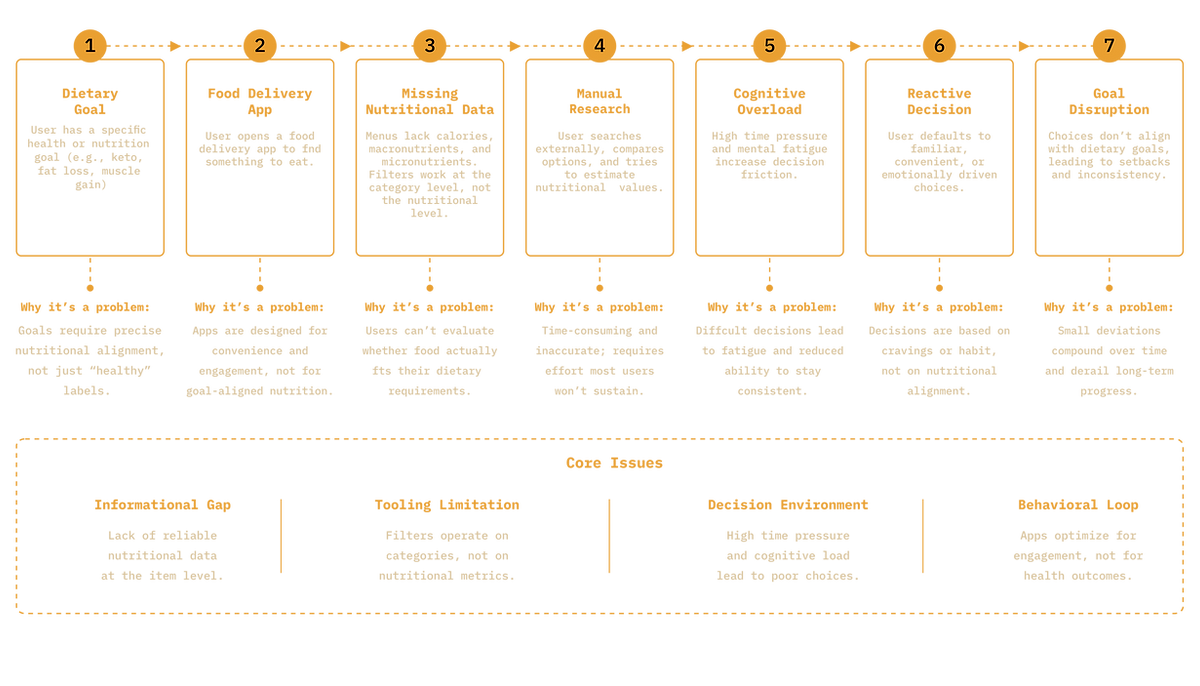
Where Nutrition Gets Lost
Difficulty discovering healthy meal options
Reactive food decisions during busy schedules
Difficulty maintaining long-term dietary consistency
Cognitive overload during meal comparison
Poor visibility into calorie and macro balance
Nutritional information overload
Lack of personalization in food ordering
Weak integration between wearable data and meal selection
Generic recommendation systems ignore user health context
Lack of operational coordination between health goals and ordering
Identifying the problem was step one. Here's what was built to solve it
PROPOSED SOLUTIONS
WHAT'S DIFFERENT
Mandatory Nutritional Transparency
The Infrastructure Layer That Makes Everything Else Possible
The foundation of the platform is a non-negotiable requirement: every restaurant listing must include complete nutritional data for every menu item, calories, protein, carbohydrates, fat, sugar, and sodium, before dishes can be made discoverable to users.
This is not a recommended field. It is a listing prerequisite.
This matters because optional nutritional labeling produces inconsistent data. Some restaurants fill it in thoroughly. Others skip it entirely. The result is a dataset too incomplete to build reliable recommendations on. By making nutritional transparency a condition of participation, the platform creates a consistent, trustworthy data layer across the entire restaurant network.
For restaurants, this requirement comes with tooling. The platform provides structured menu entry systems, nutritional calculation support, and clear onboarding guidance, reducing the operational burden of compliance while ensuring data quality across the network.

LET'S GET SMART
Apple Health & Google Health Integration
Connecting Real Health Data To Food Decisions
The platform integrates directly with Apple Health and Google Health, pulling activity data, caloric expenditure, step counts, sleep patterns, heart rate trends, and wearable device readings into the nutritional recommendation layer.
This integration changes what the AI knows about each user at the moment they open the app. A user who has had a high-activity day and burned significantly more calories than usual should receive different meal recommendations than they would on a rest day. A user whose wearable data shows consistently elevated sodium levels should see that surfaced alongside their meal options, not buried in a settings menu.
The system continuously reads health data from connected devices and adjusts recommendations accordingly. Users do not need to manually log activity or update nutritional targets. The platform adapts in real time based on what their health data actually shows.


SET GOALS, STAY INFORMED
Three Ways To Eat In Alignment With Your Goals
Restaurant Meals, Home Cooking, Or Both
Most food platforms offer one mode: order from a restaurant. This platform introduces three distinct ordering experiences, each serving a different relationship with food, all operating under the same nutritional intelligence layer.
Order A Prepared Meal
Browse restaurants and dishes filtered and ranked by dietary protocol alignment. Every item displays verified nutritional values. AI recommendations surface the most relevant options based on health data, remaining daily targets, and dietary goals.
Cook It Yourself
(Recipe-Based Grocery Ordering)
For users who prefer home cooking, the platform offers AI-curated recipe discovery aligned with their dietary protocol. Select a recipe, review the full ingredient list with pre-calculated nutritional values for the complete dish, choose which ingredients to order, and have them delivered from grocery partners on the platform.
Mix Both
Order a prepared protein from a restaurant and the supporting ingredients to cook the rest at home. The platform calculates the combined nutritional profile across both orders, ensuring the full meal still aligns with the user's daily targets.

WHEN AI COMES HANDY
AI-Assisted Recipe Discovery & Ingredient Ordering
Home Cooking Made Goal-Aligned And Frictionless
1- AI Recipe Recommendations
3- AI-Assisted Substitutions
2- Smart Ingredient Selection
4- Grocery Partner Integration
1- AI Recipe Recommendations
The recommendation engine surfaces recipes aligned with the user's active dietary protocol and current health data. A user following a ketogenic diet sees keto-compliant recipes. A user whose wearable data shows they are under their protein target for the week sees high-protein recipe options surfaced more prominently. Recipes are filtered at the nutritional level, not by category label.
2- Smart Ingredient Selection
Each recipe displays a complete ingredient list with individual nutritional contributions. Users select which ingredients they need, the AI identifies which items they are likely to already have based on ordering history, and surfaces only the missing ones by default. Every selection updates the real-time nutritional calculation for the full dish.
3- AI-Assisted Substitutions
If a recipe ingredient conflicts with the user's dietary protocol, or if the AI detects a nutritional imbalance based on health data, it suggests compliant substitutions with full nutritional comparison. Swapping regular flour for almond flour for a keto user, for example, is surfaced automatically with clear before-and-after macro visibility.
4- Grocery Partner Integration
Ingredients are sourced from grocery partners on the platform. Each ingredient listing follows the same mandatory nutritional transparency standard as restaurant menu items. Users can compare brands, check nutritional values, and select based on dietary compliance rather than just price or availability.

WHEN AI COMES HANDY
AI-Assisted Meal & Restaurant Recommendations
Suggestions Built On Dietary Goals And Real Health Data
The recommendation engine combines three data sources: the user's stated dietary preferences, their connected health data, and the verified nutritional content of available menu items, to surface the most relevant restaurants and dishes at the moment of ordering.
A user following a carnivore diet sees restaurants and dishes that actually match that protocol, not a generic "high protein" category filter. A user in a caloric deficit sees meal options with accurate caloric values prominently displayed and sorted by alignment with their remaining daily target. A user recovering from an intense training session sees higher-carbohydrate, protein-rich options flagged as appropriate for recovery nutrition.
Beyond meal suggestions, the AI provides active nutritional guidance based on wearable data. If a user's connected health data indicates consistently high sugar intake over the past week, the platform surfaces that information at the point of ordering and adjusts recommendations accordingly. If sodium levels are elevated, lower-sodium options are prioritized, and the reasoning is made visible to the user.

WHEN AI COMES HANDY
Dietary Goal Management
Keto, Low Carb, Carnivore, High Protein, And Beyond
Users define their dietary approach at onboarding and can adjust it at any time. The platform supports structured dietary protocols, ketogenic, low-carbohydrate, carnivore, high-protein, caloric deficit, maintenance, and custom macro targets and uses these as the primary filter layer through which all restaurant, dish, and recipe discovery operates.
This is not a preference tag applied loosely to menu categories. It is a nutritional filter applied directly against verified macro and caloric data. A dish is considered keto-compatible only if its verified carbohydrate content meets the threshold. A recipe only appears in high-protein discovery if its complete nutritional calculation confirms it.
As users order over time, the system tracks nutritional patterns across both restaurant orders and home-cooked meals, identifies gaps between actual intake and goal targets, and surfaces insights that help users understand whether their overall eating behavior is supporting their dietary goals.

AI + DATA
Restaurant Intelligence
Operational Insights Built From User Health Patterns
The platform creates a two-sided value exchange. While users receive nutritional guidance and goal-aligned recommendations, restaurants receive operational intelligence that helps them understand demand patterns, optimize preparation, and reach health-conscious users more effectively.
1- Demand Forecasting By Time And Area
The platform analyzes ordering patterns across its user base to identify when and where demand for specific dietary categories is highest. Restaurants can see which dietary protocols are most active in their delivery radius, at what times of day those users typically order, and how demand shifts across different days of the week.
2- Area Activity Intelligence
The platform identifies which neighborhoods and areas have the highest concentration of users with active dietary goals, surfacing this as geographic intelligence for restaurants considering menu development, promotional timing, or delivery radius decisions.
3- Menu Performance Against Dietary Demand
Restaurants can see how their existing menu performs against the dietary preferences active in their area. If a restaurant's delivery radius has a high concentration of ketogenic users but its menu has limited compliant options, the platform surfaces that gap with actionable context for menu development.
4- Menu Opportunity Intelligence
The platform identifies dietary demand that is not currently being served by available restaurant inventory. Active gap examples include high ketogenic demand in areas where compliant menu options are limited, growing high-protein demand during evening hours with insufficient restaurant coverage, rising low-sodium meal requests within specific delivery zones, and frequently requested ingredients unavailable through grocery partners.
These gaps are surfaced directly to restaurants and grocery partners as actionable revenue opportunities, showing them not just how their current menu is performing, but where unmet demand exists that they are positioned to capture.
For the platform, this intelligence transforms restaurant and grocery partner relationships from compliance-based to value-based. Partners are not just fulfilling a listing requirement; they are receiving market intelligence that directly improves their business decisions.
5- Grocery Partner Insights
For grocery partners, the intelligence layer surfaces which ingredients are most frequently ordered through recipe-based ordering in their area, which dietary protocols are driving grocery demand, and which recipe categories are growing fastest among active users.
6- New User Acquisition Through Dietary Alignment
Restaurants and grocery partners that maintain complete nutritional data and offer strong coverage across popular dietary protocols are surfaced more prominently to relevant users. Nutritional compliance is a discovery advantage, not just a listing requirement.

USER CONTROL
User Control & Editorial Responsibility
AI Suggests. Users Decide. Nothing Here Is Medical Advice.
The platform is designed as a personal nutritional awareness tool, not a medical or clinical system. Every AI-generated recommendation, whether a meal suggestion, a recipe, an ingredient substitution, or a nutritional insight drawn from wearable data, is informational in nature and intended to support personal dietary preferences, not to diagnose, treat, or manage any health condition.
Users are the sole decision-makers in every scenario. The platform surfaces options, highlights nutritional information, and provides goal-aligned suggestions, but no recommendation is prescriptive, and none should be interpreted as medical guidance. Users with specific health conditions, dietary restrictions related to medical needs, or questions about clinical nutrition should consult a qualified healthcare professional.
Within the platform, every recommendation includes full nutritional transparency, alternative options, and override controls. Users can accept a suggestion, modify it, dismiss it entirely, or adjust their dietary goals at any time. The system learns from these decisions and recalibrates, but the direction always comes from the user.
The AI assists. The user leads. That is the design principle on which this platform is built.

MAKE IT A COMPLETE SYSTEM
Designing A Scalable Nutritional Ecosystem
A Layer That Grows More Intelligent With Every Order
The platform was designed as an infrastructure layer, not a standalone application. It sits on top of existing food delivery and grocery ecosystems, extending them with nutritional intelligence rather than replacing the ordering experience users already know.
As the restaurant and grocery network grows and nutritional data becomes more comprehensive, the recommendation layer becomes more accurate. As more users connect health data, establish dietary patterns, and cook from recipes, the intelligence available to both restaurants and grocery partners becomes more precise.
The interface prioritizes behavioral simplicity and low cognitive friction across all three ordering modes. Health-conscious food decisions are already effortful. The platform's job is to make them easie, whether the user is ordering dinner from a restaurant or assembling ingredients for a meal they want to cook themselves.

LET'S TALK BUSINESS
Expected Outcomes
This platform will transform food ordering from a convenience transaction into a health-coordinated decision, whether users are ordering a prepared meal, cooking from a goal-aligned recipe, or doing both at once. Every suggestion is a starting point. Every decision belongs to the user.